Thalassan
The lands of Thalassan enjoy long, dry summers with short, wet winters. They are a proud people who love the sea and the water and boast a powerful navy. They are a devout people, favoring the worship of Anara, who they revere as a goddess. Thalassans are convinced of their own greatness, in a world that sees them as second best. Second to Gallance in culture, second to Pelegor in naval might. This has curdled in them a deep and abiding bitterness towards outsiders.
The Dancers
In the heart of Thalassan stand a pair of mountains called the Dancers, Aeliossa and Velaessa. Legend holds that Anara came to the people of Thalassan upon Aeliossa, where the prophet Aenaia ascended and spent a day and a night in the goddess’s company. When she descended, she raised the first palace at Orenassa, at the mountain’s foot, where it stands to this day. At the end of her life, Aenaia climbed Velaessa and cast herself into the ever-smoldering furnace of its volcano, giving herself to Dhaara as the first of the honored dead.
Thalassan founded
War for Marinor's Edge begins
Battle of Aelith Shoals
War for Marinor's Edge ends
The people of Thalassan boast one of the oldest cultures in Veylantia. Before the rise of Valoria, the region was a patchwork of independent palace-cities, each a small power in its own right. The empire’s conquest was swift, and for the centuries that followed Thalassan fed the provinces of Valoria with its staples. After the empire’s fall the region fractured back into its old rivalries, and a unified nation emerged only after generations of squabbling, when House Lasos brought the palace-cities under a single crown in 3003.
Lasos could not hold its throne, and after the third Lasos monarch died within two decades, House Ioessa seized the throne. Ioessa’s reign endured a century and a half, the longest peace of Thalassan’s history, until the line failed and House Assa took the seat. Assa held it scarcely three decades before losing it to House Siorain, who reigned until Queen Aepoessa’s death at the Battle of Aelith Shoals.
Aepoessa left no settled heir. Claimants from each of the four royal houses arose, and Thalassan is embroiled once more in civil war, a kingdom of many crowns and no monarch. This situation has been aggravated with the rise of the Legionnaires and the All Doctrine.
People
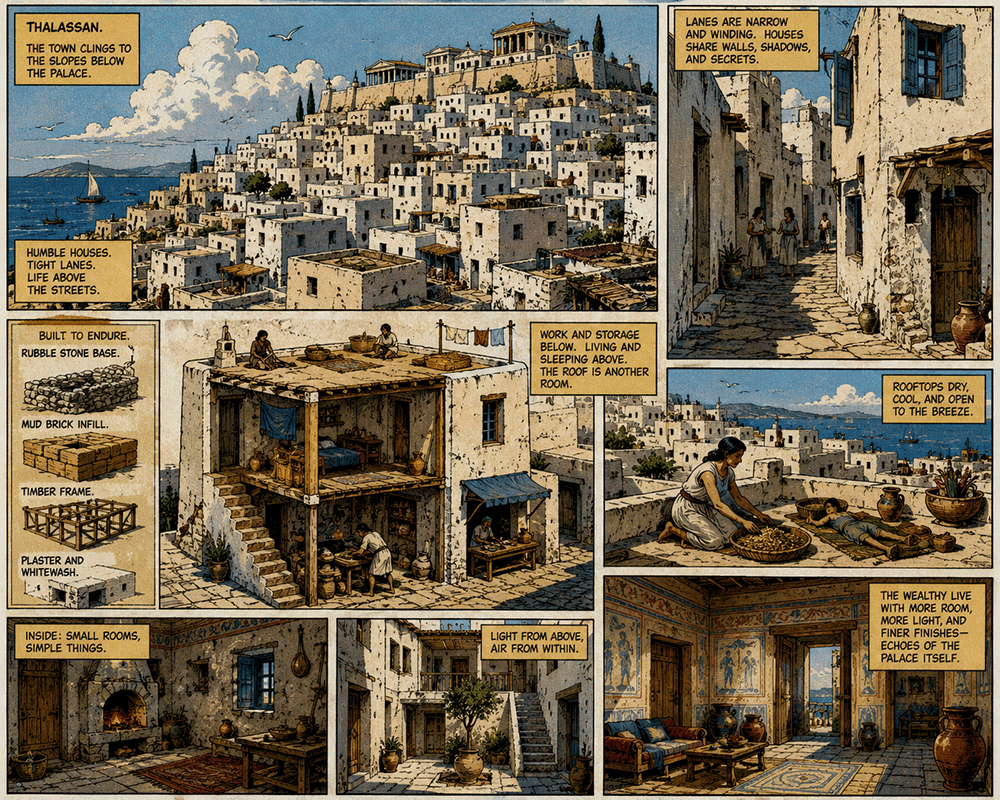
Thalassans are a proud people with a long, rich history. Built around the palace, they live in multi-storied homes with flat, functional roofs and ashlar stone. The center of any village is the palace-complex, dozens or hundreds of rooms that grow organically around the palace. Their day splits between morning and evening, with the heat of the afternoon spent at rest.
Most Thalassans live in towns or estates clustered along the coast and rich riverbeds of the central countryside. In the palace towns, mornings belong to the markets, the harbors, and the workshops; evenings to the rooftops and terraces, where Thalassans come out to be seen, to display their craft, and to measure everyone else’s. Meanwhile, on the estates, commoners toil in the olive groves, their year following the growing cycle: pruning in winter, tending through spring and summer, and a busy harvest in the autumn when the whole community floods the terraced groves and the presses run nonstop.
On feast days, holy days, festivals, and any other excuse they can find, the people gather to watch their young men and women compete in great diving contests. Contestants plunge headlong into the sea, showing off their nerve as they are judged on form and grace, the victors earning a place of honor in their community.
Religion
Thalassan has a long history of independence in belief. While it recognizes the Twin Gods, it has its own distinct branch of worship and, recently, a new faith has taken hold in its lands.
The Aenaian Rite
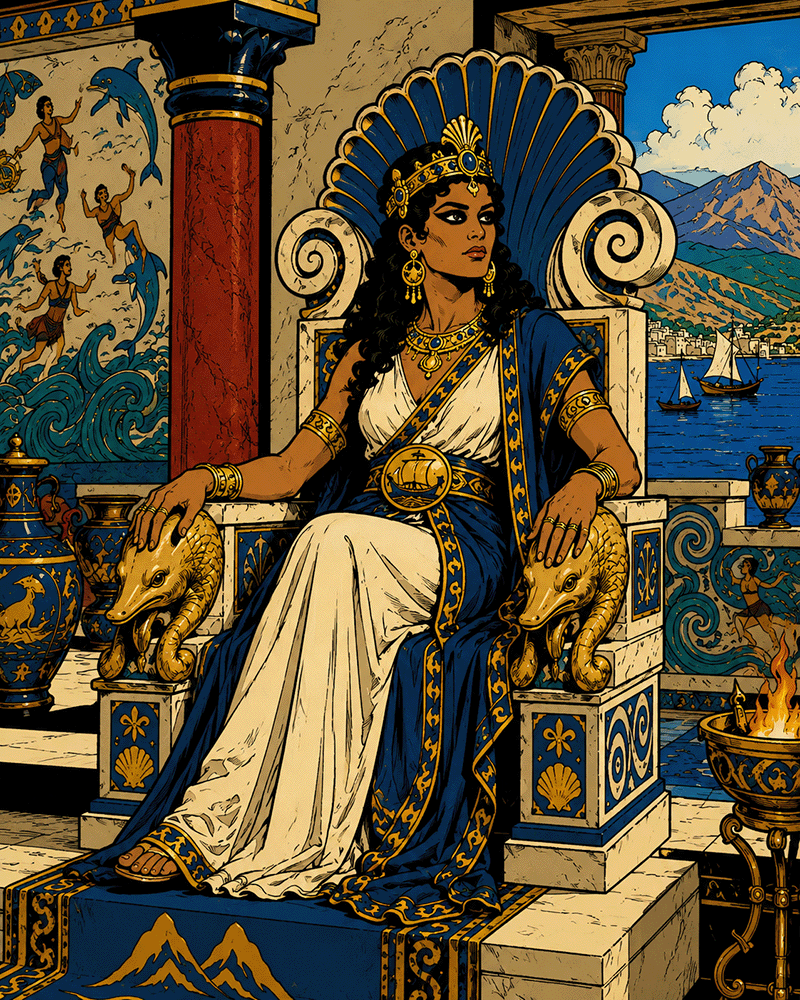
A majority of Thalassans follow the teachings of the Aenaian Rite, which arose from the legend of the Dancers. The Rite is led by the Priestess, who claims direct descent from Aenaia herself in an unbroken line. She leads from the Palace at Orenassa, at the foot of Mount Aeliossa, and she alone holds the authority to grant rulership to a Thalassan king or queen.
The all-female priesthood stands opposite the Keepers of Velaessa’s Fire, an all-male sect who carry the honored dead to Dhaara’s embrace at the volcano’s caldera. Twice in her life, the Priestess leaves Orenassa for the Palace at Morossa, at Velaessa’s foot. First, as a young woman, she travels there and remains with the Keepers for a season; when she returns, she carries the heir to the Rite, always a daughter. She comes again at the end of her life, when she has determined her time is over, to be taken up to the caldera and given into Dhaara’s embrace.
Veil of Veritas
The Veil of Veritas holds official authority over Thalassan and quietly considers the Aenaian Rite heresy. Yet it is tolerated, much as the Thalassans tolerate the Veil. Its presence in the region is muted, especially in the countryside, with few grand cathedrals to be found.
The All-Doctrine
Recently, a new religion has taken hold in Thalassan. The All-Doctrine recognizes the divinity of Anara and Dhaara, but also espouses the veneration of Morithal as a third member of the Trinity. The Veil of Veritas has branded the All-Doctrine open heresy and faithful to the abhorrent practice are to be executed.
Government
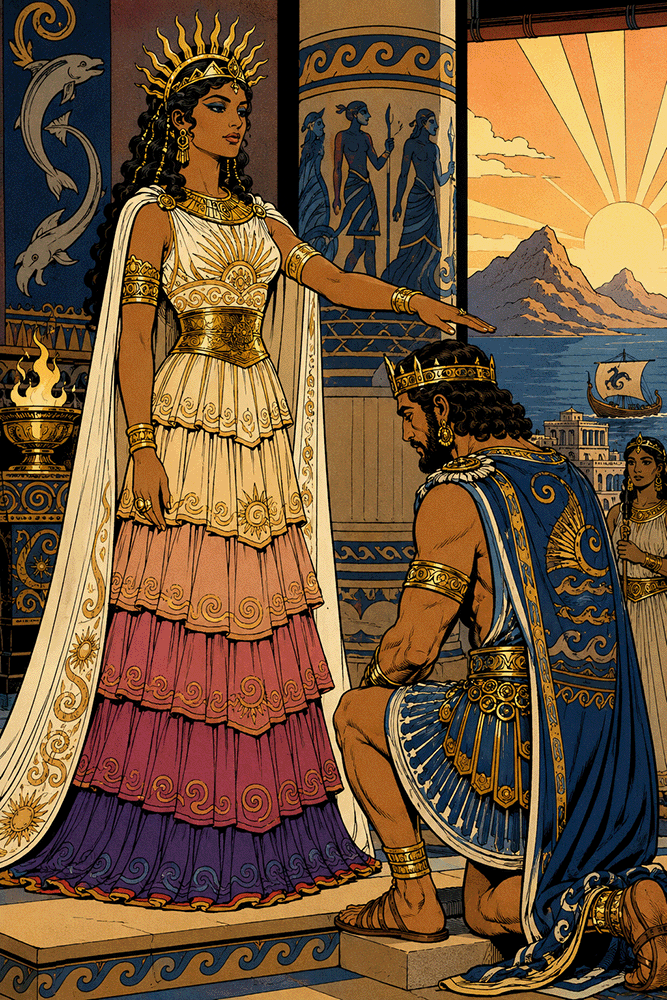
Thalassan is a sacral feudal monarchy whose authority is derived from the Twin Gods’ will as communicated by the Priestess of the Aenaian Rite. She is the only person in Thalassan with the authority to legitimize a monarch. A new monarch is always crowned at the Palace at Orenassa, after which the noble households pledge their allegiance to their ruler. Once crowned, the monarch’s rule is supreme and divinely sanctioned, and while the Priestess could in theory depose a ruler, such a thing has never been tested.
Since the death of Queen Aepoessa, the throne has stood empty. Claimants from all four major royal houses press their rights, but none has been crowned, as the Priestess has thus far withheld her blessing. As a result, the country has fallen into chaos. To the east, Palatine Niron of House Siorain has declared Los an independent kingdom, separate from Thalassan. The three remaining Palatines fight for dominion of the rest, though even victory will not guarantee their ascent, for only the Priestess can make a monarch.
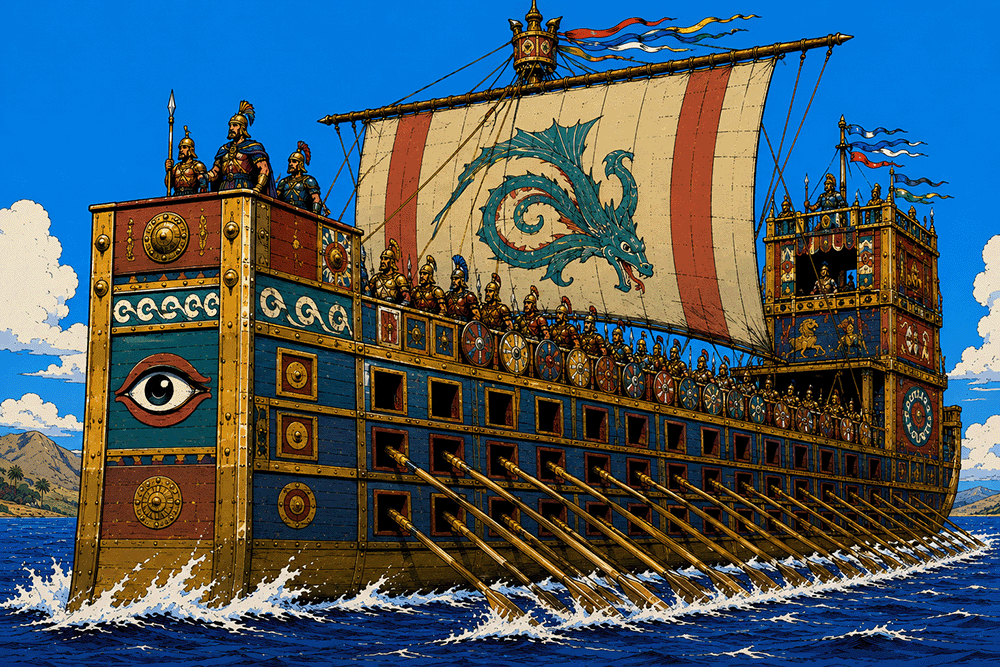
The Thalassan military pairs a powerful navy with an army built around a small number of highly trained warriors. At sea they rely on heavy, multi-tiered warships, floating fortresses with fighting castles fore and aft, crowded with marines for boarding actions. Those marines, the Thaloi (THAL-oy), are trained to the spear and shield and renowned for their close fighting. They are as deadly on a boarded deck as in the water or on land, but their low numbers mean that Thalassan has never been a strong land power, a weakness Valoria exposed when it took the region in a single swift campaign.